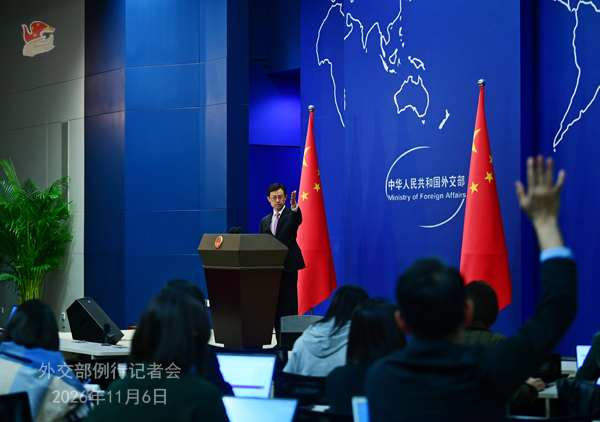
Foreign Ministry Spokesperson Guo Jiakun’s Regular Press Conference on November 6, 2026
As agreed between China and Canada, the second China-Canada Economic and Financial Strategic Dialogue will be held in Canada on November 9. Member of the Political Bureau of the CPC Central Committee and Vice Premier of the State Council He Lifeng will co-chair the dialogue as the Chinese lead person with the co-leaders on the Canadian side Minister of Finance and National Revenue Francois-Philippe Champagne and Minister of International Trade Maninder Sidhu.
The Paper: The Ninth China International Import Expo (CIIE) and the Hongqiao International Economic Forum Opening Ceremony was held in Shanghai yesterday. The 140th China Import and Export Fair (Canton Fair) also concluded this Wednesday. We have seen media reviews saying that the two expos, held back-to-back, show that China—both the world’s factory and world’s market, both a “super seller” and a “super buyer”—plays an important role in addressing imbalanced trade. What’s your comment?
Guo Jiakun: These expos you mentioned are important windows on China’s global connectedness and how it enables development and delivers for the people across the world. In his keynote speech at the CIIE opening ceremony, Vice Premier Ding Xuexiang noted that the CIIE, since its inception, has witnessed China’s firm resolve and concrete actions to advance high-standard opening up, the tangible outcomes and substantial benefits achieved by businesses and people from all countries in sharing opportunities in the Chinese market, and the unremitting efforts and important contributions of people from all sectors to improving global economic governance.
Vice Premier Ding Xuexiang shared four observations on realizing the balance of trade. First, countries should share market opportunities, enhance openness and connectivity, better leverage their respective comparative advantages, and promote balance by making the economic pie bigger together. Second, countries should engage in deeper investment cooperation, make efforts to optimize the cross-border layout of industries, create favorable conditions for businesses, and promote balance through integration into global industrial and supply chains. Third, countries should harness innovation, improve supply quality, expand the frontiers of trade, and promote balance through advancing transformation and upgrading. Fourth, countries should enhance mutual understanding and trust, give due consideration to each other’s legitimate concerns, resolve differences through consultation, and promote balance by removing barriers.
China will work with relevant parties to make the CIIE successful, fully leverage the four major platforms of international procurement, investment promotion, people-to-people exchanges, and openness and cooperation, and bring more benefits to the people of countries around the world.
Reuters: China has consistently been open to expanding purchases of agricultural goods from the U.S., but only on the condition that the two sides implement their agreed US$30 billion-for-US$30 billion reciprocal tariff-reduction arrangement, Commerce Ministry spokesperson said yesterday. Does this mean that China will not begin fulfilling the US$17 billion agriculture pledge until the tariffs are cut?
Guo Jiakun: I’d refer you to China’s competent authorities for the specifics. Maintaining the steady development of China-U.S. economic and trade relations is in the interest of both countries and peoples, and conducive to global economic growth. The two sides need to move in the same direction, adhere to mutual benefit and win-win results and promote the continued, steady development and improvement of China-U.S. economic and trade ties.
NHK: Tomorrow marks one year since Japanese Prime Minister Sanae Takaichi made the comments on Taiwan at the Diet. Does China plan to once again ask the Japanese side to withdraw the comments? What is China’s position on the current and future China-Japan relations? (Similar question from Yomiuri Shimbun)
Guo Jiakun: The current serious difficulties in China-Japan relations are entirely the responsibility of the Japanese side. It stems from the erroneous remarks made by the Japanese leader a year ago regarding Taiwan, which blatantly signaled a potential military intervention in the Taiwan question, challenged China’s national sovereignty, and undermined the political foundation of China-Japan relations. Regrettably, one year on, the Japanese authorities have not moved at all. They’ve been evading the issue and yet to demonstrate any sincerity or take any action to reflect upon and correct the wrongdoings.
Our position on China-Japan relations has been consistent. We wish to reiterate that for the Japanese side, the pressing priority is to correct the erroneous words and deeds on the Taiwan question, adopt a correct attitude on historical issues, and form an objective and rational perception on China.
Xinhua News Agency: A recent Forbes article compared the Africa policies of China and the United States, saying that Washington’s policy has been transactional and narrowed largely to securing key minerals, while China’s philosophy is long-term: build what Africa needs, finance it, and let the host countries govern, thus accumulating influence and enjoying a high rate of recognition. Afrobarometer’s report finds 62 percent of Africans view China’s influence positively. Do you have any comment on this?
Guo Jiakun: China and African countries naturally belong to a community with a shared future. China always supports Africa’s efforts to pursue development, revitalization and collective strength under the principles of sincerity, real results, amity and good faith.
From May 1 this year, China began the zero-tariff treatment for all 53 African countries having diplomatic ties with China. The policy enables easier access for African agricultural products and light manufactured goods to the Chinese market, and introduces special African products such as avocado, coffee bean, pecan and shea butter to households across China. In the first nine months of this year, China-Africa trade volume exceeded US$310 billion, up by 22 percent year-on-year. This policy has effectively lowered cost for China-Africa trade and brought tangible benefit to more African small and medium-sized enterprises and farmers.
No matter how the international landscape might evolve, China is always the most trustworthy and reliable partner for African countries. China-Africa high-quality cooperation will continue boosting both sides’ modernization drive.
AFP: In Macao today, a court sentenced former lawmaker Au Kam San to 12.5 years in prison after he was found guilty of working with foreign forces to subvert state authority. Does the foreign ministry have a comment on this?
Guo Jiakun: The court of the Macao SAR has released information regarding the sentencing in this case.
Let me stress, Macao upholds the rule of law. To abide by the law and bring lawbreakers to justice is a basic principle. No one enjoys any privilege above the law. The Macao SAR has the duty and right to handle in accordance with law suspected acts of colluding with external forces to endanger national security. This is consistent with international law and common international practice, has solid legal basis and is fully justified.
The implementation of One Country, Two Systems in Macao since its return has achieved great success recognized by all. The constitutional order based on the Constitution and the Basic Law of the Macao SAR has been firmly established. The SAR’s economy has attained historic leaps and people’s livelihoods have continued to improve amid social harmony and stability. The extensive rights and freedoms Macao residents are entitled to under the Basic Law are fully protected. These are facts there for all to see.
The central government firmly supports the Macao SAR in punishing acts and activities endangering national security in accordance with law and firmly opposes any external forces using individual judicial cases to interfere in Macao’s internal affairs and meddle in China’s internal affairs.
AFP: Yesterday, the U.S. State Department imposed new sanctions related to Cuba, including on two Chinese companies it accuses of supplying Cuba’s military with electronics and security equipment. Does the foreign ministry have a response to this?
Guo Jiakun: China-Cuba cooperation is completely above-board. China stands firmly against illicit unilateral sanctions that have no basis in international law and lack UN Security Council authorization, as well as the so-called “long-arm jurisdiction.” We reject attempts by the U.S. side to disrupt and sabotage China-Cuba cooperation and firmly support Cuba in safeguarding national sovereignty and opposing external interference. We will take all measures necessary to resolutely protect the legitimate rights and interests of Chinese businesses.
Beijing Daily: According to reports, results of Grenada’s general elections released on November 5 local time show that incumbent Prime Minister Dickon Mitchell is set to secure another term in office. What’s China’s comment?
Guo Jiakun: China congratulates Prime Minister Dickon Mitchell on his reelection. Grenada is China’s important cooperation partner in the Caribbean. We stand ready to work with Grenada to further deepen our mutually beneficial and friendly cooperation and deliver more benefits for both peoples.